Good people, it is very amazing. Through some sponsors, the cost of my Vanguard Executive Masterclass has dropped from N350,000 to N150,000. If you have paid since I posted it here yesterday, you will be getting a refund.
We’re expecting more sponsors, and if someone/company writes the full cheque, the workshop becomes completely FREE to those that have paid.
As always, I remain humble on how my fellow citizens support any venture or initiative I pursue in our nation. Tell your supervisors, managers, and register today by contacting:
Jude on 08034187233
Ife on 09095372559
Email:Conferences@vanguardngr.com
To learn more about this workshop including theme, structure, etc, please click here.
I bought a calculator for my son. He is 8 years old, and is in primary 4. His school, just like every other primary school in Nigeria, doesn’t use calculators for primary school pupils. But I still bought a calculator for him, only that he will use it at home for his homework. I don’t allow him to use it for all his calculations because he won’t be allowed to use it during exams; so I didn’t want him stuck in the exam hall.
I will give anything for the reaction I got from my son for such a little gift. He was so happy. He kept thanking, blessing and praying for me. He said I made him feel like he’s in secondary school (lol). The best part of it was that he immediately started writing down numbers on papers to calculate and all. Honestly, I’ve never seen my boy feeling so happy and grown up, not even when I bought a dictionary for him.
For reasons I am yet to understand, Nigerian schools are skeptical about introducing school children to the use of calculators until they get to their senior secondary school classes. If you ask me I’ll say Nigerians enjoy making things so difficult for themselves and for others. We want our children to be computer gurus immediately we give birth to them but we think that using calculators in solving math problems will ‘dull their brains’. This sounds so paradoxical if I may say.
In this age when exams are becoming computer based we are still clinging so hard to old ways of doing things. I could remember that during our time JAMB doesn’t allow candidates to come into the exam hall with calculators, yet they want them to solve lots of mathematical problems within a very short time. Now they are allowing in only customised ‘adding machine’ in place of a good scientific calculator.
But my problem today isn’t with JAMB, it is Nigerian primary and junior secondary schools that wouldn’t allow students to solve problems with the aid of machines. Anytime I complain about this, the ‘educationists’ around never hesitate to tell me that calculators are not good for students. I believe the Nigerian education system does not give room for the use of calculators in these schools. Teachers themselves believe that it shouldn’t be introduced into the education system.
Below are some of the assumptions given by some Nigerian educationists on why calculators should be kept away from school children:
a. Calculators make children less analytical. This of course is a fallacy. If someone is not analytical, the person won’t know what to ‘press’ on the calculator.
b. Calculators do not encourage the development of problem-solving skills. Well, calculator, as far as I know, helps people to solve problems faster. So I guess the person already has the problem-solving skills before using the calculator.
c. The use of calculator reduces someone’s self-confidence. I believe what they meant here is that the person will be so dependent on machine that without it, he will feel lost. Well, teachers should find a way to help their students not to become dependent on machines. The students can alternate between using and not using calculators to solve problems.
d. Using calculators do not help students to develop and sharpen their mathematical skills. The person that said this made reference to primary school pupils not being able to solve simple calculations using place values. Well, that is not an excuse for not introducing calculators early, don’t you think?
e. Calculator makes students lazy. You won’t believe that the teacher that said this is teaching Mathematics to SS 3 students. I don’t know what Nigerians see in stress and suffering. Well, if being lazy is the only way to find the easy way out, then let our students be lazy.
To refute the above assumptions, I will mention the changes I noticed in my son these few weeks I introduced him to a calculator. These changes are:
1. He is motivated to do his homework. Before, he drags his feet each time he has math homework that will require much calculations. The thought of placing numbers and marking out strokes seem to discourage him. But since he got this calculator, he couldn’t wait to do his math homework once he gets home.
2. He became faster with his calculations. I don’t know why but I noticed that calculating numbers seems easier for him now, even without using calculators. I think the calculator has taught him the answers to some common additions and subtractions. He can now look at some simple additions or subtractions and tell you their answers even without working them out.
3. He searches for his errors. Unlike before, if he makes a mistake and I tell him, he will just say, “mummy, leave it like that.” But now, if his calculates without his calculator, crosschecks the answer with the calculator and sees that he failed it, he will try to locate where the error is coming from. It is as if the use of calculator has made him not to see his homework as tiring.
4. He feels in-charge and confident. Maybe this is because the calculator tells him he got some answers right and also because he has a simple machine to take care of. I don’t really know but I can see the boy is feeling all grown-up these days.
5. He loves math once again. I think this is the best of them all. When he was in nursery school till he got to primary 1, he preferred his math assignment than any other one. This positive attitude towards math changed as he got to primary 3. But I’m happy he has gone back to his old self again.
All I am advocating for is that we begin early to introduce our children to calculators. This exercise should start from primary 3, or primary 4. I don’t think this will discourage our children from learning and developing mathematical skills; it will rather make them see it as an easy subject.
The world is fast changing and getting advanced; let us not allow it to pass us by.
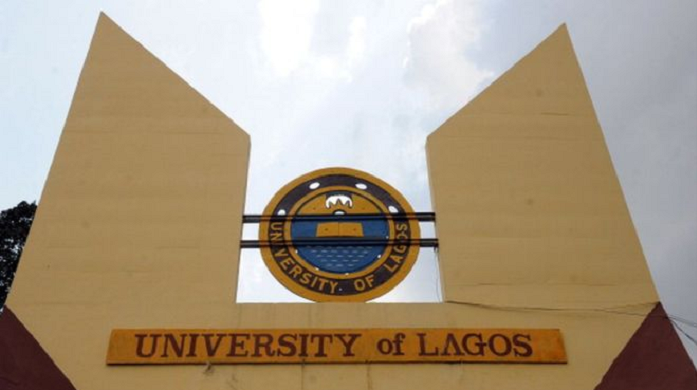
Some weeks ago, I came across aflyer on the twitter handle of the University of Lagos advertising a career week organized for students of the university in their final year. I was happy and excited by the fact that such an event is happening in UNILAG. The advertised programme, with the theme “Grab your Job/ Empowered to be your own boss”, was organised by the Counselling Centre of the Students’ Affairs Division of the university. The aim, according to the flyer, was to expose the students to requisite mindset and relevant skills for success in the world of work. The four-day programme covered training on job hunting, employability skills, CV crafting, job creation and skill acquisition. It also included dummy interview, job test and interaction with human resources experts.
With the frightening statistics of unemployment among Nigerian graduates, the training which was held in September this year was a right step in the right direction. The university should be commended for a number of reasons. One, being a public federal university, one does not expect that it would get to that level of innovation as quickly as this. Government owned institutions in Nigeria are not competitive. They do not look for students. Theirs is just to float a course, advertise and students would either rush or be forced to study such courses when their scores do not meet the cut off point.
Second, the fact that the programmes was conceived and executed also indicated that the university is waking up to the realities of education in this era. Global best practice dictates that universities do not only admit and train students for four or five years, they also ensure they give their graduates the needed training, exposure and connection. The return on investment is high. Such alumni would look back to reward the system that secures their future for them. The students can also have an idea, like the Stutern Report indicates, whether they stand to profit from the tuition and other fees paid while getting trained.
Third, the university has also attached some level of importance to the exit phase of the students’ life on campus. Before now, the tradition is to focus on the entry point. Tertiary institutions organise orientation programmes for newly admitted students. During these programmes, they enlighten the fresh students on university’s rules and regulations, sources and dangers of distractions and other issues they deem important to the survival of students on campus. Therefore, it is commendable that students in their final year of study are now being considered too. Creating such avenues would enable the students to have some level of clarity as far as post university issues are concerned.
Fourth, the university is located in the commercial and creative capital of Nigeria is leveraging on the town and gown collaboration. Even though not stated in the flyer, it is easy to add that such a programme is birthed by some kind of cross fertilization of ideas between the concerned units of the Students’ Affairs as well as selected human resources and recruitment agencies in the city. Such efforts can facilitate discovery of talents of brilliant students and get them the needed jobs. It is indeed a move that should be well applauded.
It is my hope that other universities, whether private or public, would emulate what UNILAG has done in the area of graduate career and employability development. The issue of unemployment in Nigeria is a time bomb which all concerned stakeholders must work together to diffuse.
World Teachers’ Day, also known as International Teachers Day, is an international day held annually on October 5. The 2019 International Teachers Day Celebration Memoir takes a look at the perspective of Nigerian Teachers. In this article, the current state and future of Teachers is Examined.
Held annually on 5 October since 1994, World Teachers’ Day commemorates the anniversary of the adoption of the 1966 ILO/UNESCO Recommendation concerning the Status of Teachers. This Recommendation sets benchmarks regarding the rights and responsibilities of teachers and standards for their initial preparation and further education, recruitment, employment, and teaching and learning conditions. The Recommendation concerning the Status of Higher-Education Teaching Personnel was adopted in 1997 to complement the 1966 Recommendation by covering teaching and research personnel in higher education.
With the adoption of the Sustainable Development Goal 4 on education, and the dedicated target (SDG 4.c) recognizing teachers as key to the achievement of the Education 2030 agenda, WTD has become the occasion to mark progress and reflect on ways to counter the remaining challenges for the promotion of the teaching profession. World Teachers’ Day is co-convened in partnership with UNICEF, UNDP, the International Labour Organization, and Education International.
The major importance of the World Teachers Day is to celebrate World Teachers’, the UNESCO and Education International (EI) mounts a campaign each year to help give the world better understanding of teachers and the role they play in the development of students and society. They partner with the private sector such as media organizations to achieve this purpose.
Nigerian Teachers
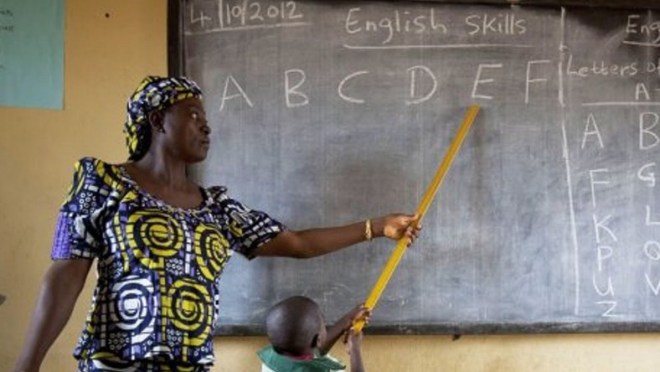
A Nigerian Female Teacher Assists a Child to Learn the English Alphabets. Courtesy, Plus NG.
From the small to the top, the challenges facing Nigerian Teachers and Education in Nigeria includes: inadequate funding, poor societal perception of teacher education; lack of commitment among Education stakeholders; problem of attrition in teaching; lack of motivation; unethical behavior of some education bodies and more.
The Nigerian teacher is resilient and motivated to keep impacting knowledge regardless of the harsh circumstances. Being a Nigerian from birth, I have felt the impact of teachers all my life. Painful enough, most of the teachers who provided the framework for our growth are those we must have lost contact with, probably because of location and other issues. We have to acknowledge the hard truth that no country on earth will have any Human Resource capacity without the hard-work of the Hardworking Teachers.
It has been stated that teachers are one of the most influential forces for equity, access and quality in education, for this reason there should be a high placed much emphasis on Human Capital Development. Over the years, Educational Institutions have become targets, ranging from kidnappings, killings, arson, vandalism and hooliganism. Conflict and natural disasters have also led to schools being closed down and converted to camps for Internally Displaced Persons thereby disrupting schooling. These all are scary situations facing the Nigerian Teacher and Nigerian Education System.
The Future of the Nigerian Teacher and Nigerian Education System
What is the future of the Nigerian Teacher? This Question is not a rhetorical one, it has never been. The future is always here! But how will it be attained. The Nigerian Teacher, has groomed many successful humans across the globe. Medical Doctors, Lawyers, Technologists, Inventors, Business Tycoons, Musicians, Lawmakers, Politicians, Journalists, Teachers (Lecturers at the Tertiary Level), and many more individuals have all passed through a Teacher!
As the 2019 International Day Recognition of Teachers is observed here are some steps Teachers in Nigeria can be honored. They include:
1. Increased Salary Payment: According to FixusJobs.com, they are at the very bottom of the salary scale for teachers in Nigeria. The average salary for Nigerian teachers in primary schools is 15,000 Naira. The high school teachers get more?—N37,000. According to naijaquest.com basic teachers salary in Lagos is N57,000, and in Abuja, the wages of teachers can reach N60,000. mysalaryscale.com claims that the average wage in the salary structure of teachers in Nigeria is N47,000.
Wages of primary schools teachers are in the lowest point of teachers salary structure, their average salary is N15,000. As for private school teachers, their salary level is around N67,000. There are also several prestigious private schools, where the salary level is much higher than in average schools.
Ayoola Mobayo, a Digital Business and Mobile Tech Management Expert opined his views on this matter: “I seriously think Teachers should have the highest take home, In-fact they’re so Invaluable.”
Unfortunately, teachers salary structure in Nigeria is not well developed and small wages don’t attract young specialists. In this situation, many young teachers decide to change profession in search of bigger salaries. As a result, many schools around the country, and especially in rural areas lack enough teachers. It is difficult to say how the situation can be changed in the future. We see several new governmental programs, designed to raise the wages and attract youth to teaching profession. There are also a big number of teachers who feel very enthusiastic about their work, who consider it as a way to help children, but in any case, the government should not forget the importance of this profession, and to support teachers, because education of citizens is one of the main aspects of development for the whole country.
2. More Appreciation: Michael (Mike) O’Connor of the Service Professionals Network stated opined: “We Need to Appreciate Teachers More!”. Ask yourself when was the last time you sent your teacher an appreciative note, a tip, a gift, a letter or even a hug or any positive remarkable thing. Teachers are humans too, they deserve the Love and Commendation from you too. Yes, you can brighten up their day. Doing this will go a long way to impact much more on your teachers and make their humanitarian services flow more easy.
3. Improvement on Teachers Learning Scheme: When the Kaduna State governor, Malam Nasir el-Rufai raised the alarm on the abysmal poor quality of primary school teachers in the state who sat for a test ordinarily administered to primary four pupils. Of the 33,000 teachers who wrote the examination, 21,780 representing 66 per cent of the total number, failed. If this same test were to be administered to teachers in some other parts of the country, the result may not be much different. The level to which our teachers, especially at the primary level of education, have sunk is disheartening. Urgent measures ought to be taken by all the relevant stakeholders, with the government leading the way, to correct it.
4. Investment in Education: The best way out of poverty is through investment in education, especially those who deliver it. Why is Nigeria’s case so different? We must begin to quickly retrace our steps, starting with the commitment of the present administration as indicated by the Education Minister. The size of the budget for education must significantly improve next year as a first sure sign of our resolve to change and do things differently. The Nigerian Government must put high priority on allocating high resources in Education. For instance, the Budgetary provision for education in the 2019 budget has again fallen below the 15 per cent to 20 per cent minimum recommended for developing countries by the United Nations Educational Scientific and Cultural Organisation.
On December 19 presented N8.83tn estimates to the National Assembly as this year’s budget. The executive summary of the proposals, according to The Punch check on Thursday in Abuja, showed that the education sector got N620.5bn (about 7.05 per cent), marginal raise over the total of N605.8bn budgeted for the sector in 2018. Over some years, the country’s funding for education continued to rotate between five per cent, six per cent and seven per cent of the national budget.
During President Buhari’s visit to France in November 2018, he assured the Nigerian community there that education would be better funded this year. He had said, “We are currently reviewing investments in the entire infrastructure of the country like road, rail and power, including investing more in education. We will certainly need to do more in education.” But here’s the Shocker, in the 2019 budget, the Federal Government still stuck with the five to seven per cent region.
The country budgeted N398bn on education in 2017. In 2018, Buhari initially proposed N496.9bn, but it was later raised to about N605.8bn by the National Assembly. Incidentally, the budget was later cut as part of the virement for the Independent National Electoral Commission to prepare for February’s polls. Reacting to this year’s allocation, the National President of the Academic Staff Union of Universities, Prof. Biodun Ogunyemi, said that it had vindicated the union’s consistent demand that education should be adequately funded in the country. He said, “The budget (N620.5bn) is to prove to you that the ruling class in Nigeria does not prioritise education. This Punch Edition has more here.
Conclusion
To be honest and realistic, all wise nations prioritise teachers and matters pertaining to their welfare so that they can continue to reap dividends from their very important exertions. Nigeria must continue to put great emphasis on teachers and the work that they do so that it will be well with our youths and the country.
In all of the countries where giant strides have been made in the development and rapid industrialization, the prioritization of the teaching profession has been a cardinal policy. Check the United States, Japan, Germany, South Korea, Singapore and China, the strategy has been largely the same: putting great accent on the training and remuneration of teachers and providing everything that is required for the proper education of children.
In Nigeria, the story was not always this dismal. In pre-independence times, right up to the First Republic, the teacher was a very significant and respected member of the community. This enviable profile reflected in the quality of those recruited into the profession and more importantly, impacted positively on the amount of sacrifices they made for the betterment of their wards and charges.
Gradually and ironically, with improved earnings from oil, the teacher began to lose his place in the scheme of things in the country. Matters concerning him and his work environment were consigned to the back quarters and right before our very eyes, the teacher diminished in importance. As a result, no one who had ambition and thought highly of himself wanted anything to do with the profession as it became a last resort and dumping ground of sorts. This is one of the reasons we are where we are on all indices of development.
Do I Join This 2019 International Teachers Day Celebration?
You would ask that. I know. Yes, I join the movement. Nigeria has only two million registered teachers?—?TRCN. The Federal Government has said that although Nigeria has two million qualified and registered teachers, the country is in need of 250,000 teachers annually to cater to the growing population of pupils.
Here is my Post:
Dear Life,
To all the teachers that made us who and what we are today, words can’t express how I feel when I think of all the sacrifices done for me.
I’m grateful for the patient and loving efforts bestowed to me by you by his Grace.
Wherever you may be, may blessings continue to follow you and your loved ones.
Blessings!
Keep Appreciating your Teachers and have yourself Happy International Teachers Day!
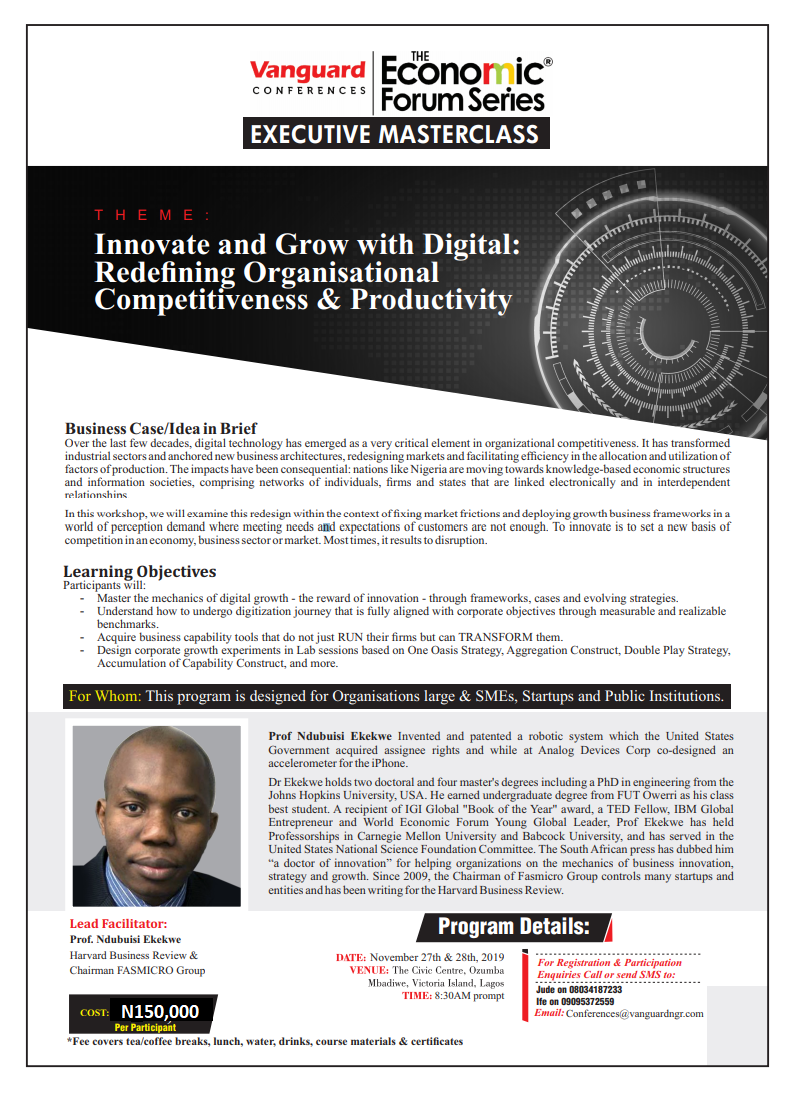
It’s official – Vanguard Executive Masterclass will be facilitated by yours truly, Prof Ndubuisi Ekekwe. I invite staff and leaders of startups, SMEs, large firms and public institutions to join me on 27 & 28 Nov, 2019 in Lagos as we examine markets, strategies and how to unlock opportunities across sectors. I have done this in Fortune 500, HBS and some of the largest banking institutions in the world. It would be live in Lagos. Yes, two days of understanding the deep mechanics of business under a theme – “Innovate and Grow with Digital: Redefining Organisational Competitiveness and Productivity”.
For Registration & Participation Enquiries, Call or send SMS to:
Jude on 08034187233
Ife on 09095372559
Email:Conferences@vanguardngr.com
The amount is N150,000.
Date: 2nd & 3rd Dec 2019.
Venue: 2nd Floor, Conference Support Services, LCCI Conference & Exhibition Centre, Nurudeen Olowopopo Way, Behind Marwa Gardens, Alausa Ikeja
Register today.
Innovate and Grow with Digital: Redefining Organisational Competitiveness and Productivity
Over the last few decades, digital technology has emerged as a very critical element in organizational competitiveness. It has transformed industrial sectors and anchored new business architectures, redesigning markets and facilitating efficiency in the allocation and utilization of factors of production. The impacts have been consequential: nations like Nigeria are moving towards knowledge-based economic structures and information societies, comprising networks of individuals, firms and states that are linked electronically and in interdependent relationships. In this workshop, we will examine this redesign within the context of fixing market frictions and deploying growth business frameworks in a world of perception demand where meeting needs and expectations of customers are not enough.
Day 1 – Innovation Discovery
Day 2- Growth Execution
Morning Session
Morning Session
The beginning: fixing market frictions
State of the Tech Nation
Emerging trends and opportunities
Emerging technologies and competition
Digital Innovation frameworks and constructs
Lessons from innovation cases: Nigeria, Africa and World
The redesign: IT for productivity, Internet for zero marginal cost